





If you like what you've seen so far, now's the time to check the car's paperwork - to note a few details and make a couple of phone calls.
 Half
a million cars are stolen in the UK each year. If you're conned into buying
one, or one with finance still owing on it, you could end up not only losing the
car but the money you paid for it. Insurance write-offs may have been in a serious
accident so could, if they've not been properly repaired, be dangerous to drive.
Half
a million cars are stolen in the UK each year. If you're conned into buying
one, or one with finance still owing on it, you could end up not only losing the
car but the money you paid for it. Insurance write-offs may have been in a serious
accident so could, if they've not been properly repaired, be dangerous to drive.
Ask to see the car's registration document (the V5C form, sometimes called the car's 'logbook'), service records, MoT certificate and handbook.
Never
buy a car without a V5C registration document.
If the seller is unable
to produce it for any reason, walk away.
First
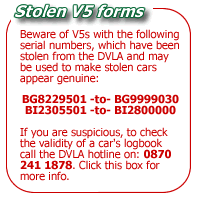
check the V5C is genuine by looking for the watermark and check the
serial
number isn't in the range of stolen ones listed above.
Next
ask for proof of the seller's name & address and check it matches what's
on
the form. If buying privately, you should be doing the deal at the address
shown
on the V5C.
Then
check the registration number, car description and chassis number on the form
all match the car you're looking at. Look for the car's data plate (often
called
a 'VIN' plate), often found under the bonnet. Look particularly closely
at
the condition of the plate and the metalwork around it when you do this to
spot
signs of tampering. If in doubt, the chassis number should be stamped
somewhere
else on the car too - often around the driver's door sill, or visible through
the base of the windscreen. Look in the car's manual to find where it should be
and check all numbers match.
This
will help you avoid buying a 'clone' - a stolen car that's been given the
identity of a similar, legitimate one that's already on the road. The number
stamped
on the chassis is far harder to alter than the car's number plates or VIN
plate
under the bonnet.
KwikTip:
always get a car insurance quote from Direct
Line too,
as they don't take part in the price comparison websites.
Next
check the MoT certificate - check the details against the car (Make, Model,
Colour, Mileage, VIN) and check the MoT expires when the seller says. Unlike the
old watermarked documents, these days MoT certificates are little
more than
a printed receipt. So you should double-check the certificate is
genuine at
the MoT Status page
of the government website. To do this you'll
need either the car's registration
number plus the MoT test number from the certificate -OR- just the document number
from the car's V5 form.
But
remember, an MoT is no guarantee that the car's roadworthy. It's just a snapshot
of the car's condition at the moment it was tested. You should have
given
the car a thorough inspection already to get
an idea of its current condition.
Service records: Hopefully the car will have a good file of service receipts or, ideally, an up-to-date service record book full of main dealer stamps at the right intervals. A lack of receipts indicates a car that hasn't been cared for and which might prove unreliable. Check the records for who has been doing the servicing, what work has been done and whether anything has had persistent attention but may still be unresolved. If there are old MoT 'advisory' report sheets, see if any warnings of looming faults were noted and check that they've been fixed - or you could be hit for the bill next time around.
Check
the mileage. Old MoT certificates used to be best for checking how a car's
mileage has changed. If the owner has kept them, that's a good sign. Look through
them if available, but bear in mind recent versions of the MoT certificate can
now be easily forged. You're looking to see if the mileage has progressed in
a
normal way over the years, bearing in mind the average is 10,000 miles a year.
And check the mileage on the latest MoT certificate against that shown in the
car.
Make
enquiries: If at a dealer, or if the car has recently changed hands, note
the name and address of its previous keeper from the V5. Get their number
from directory enquiries if you can and give them a quick call. Ask them if they
had
any problems with the car, how they used it, why they sold it and what
the
mileage was when they sold it. It's no skin off their nose to tell you
the truth.
For extra reassurance, contact a company that checks the
previous
history of cars, like Experian Autocheck or HPI.
For their own reassurance, a
car dealer should have done this already, so
ask to see the report. If buying privately, a history check is essential. It'll
tell you if the car has ever been
declared an insurance write-off, whether
there's any finance still owing on it, whether it has ever been stolen and may
even provide mileage information to
help check if the car has been clocked.
A
check can be done over the phone or online. You'll need a credit card, the
car's
registration number and its 17-digit VIN / chassis number.
Warranty:
Find out what's covered and what's not. Does it cover parts and
labour?
Will anything invalidate it? Would you have to contribute towards a
claim
- is there an excess? Is there a financial limit per claim or limits to how
often
you can claim?
Handbook:
Finally, does the owner have the car's handbook? You'll need one as
it contains
all the useful information about how to operate the features of the car and maintain
it like tyre pressures and fluid specifications. If not, it will be
possible
to obtain a replacement.
Next
page:
how
to haggle over a car's price >>